UK Sanctions Cryptomus as Global Crackdown on Illicit Crypto Payment Hubs Intensifies

The United Kingdom has officially designated the cryptocurrency platform Cryptomus as a target for rigorous economic sanctions, marking a significant escalation in the international effort to dismantle the financial infrastructure supporting Russian-linked cybercrime. This decisive move by the British government aims to sever the platform’s access to the U.K. financial system, effectively freezing any assets held within the country and prohibiting British entities from engaging in commercial activities with the firm. Cryptomus, which has operated under various aliases including Certa Payments and Xeltox Enterprises, is accused of functioning as a primary conduit for illicit funds, ranging from ransomware payments and narcotics trafficking to the facilitation of fraudulent cyber-services that help the Russian state circumvent global economic restrictions.
The Mechanics of a Chameleonic Operation
Cryptomus is far from a standard cryptocurrency exchange. Since its inception in 2022, the platform has maintained a "chameleonic" corporate structure, frequently rebranding and shifting its operational identity to evade regulatory scrutiny. The most recent iteration of this strategy involved the launch of "Heleket," a parallel service designed to continue "no-KYC" (Know Your Customer) payment processing after its predecessor faced a record-shattering CAD $176 million fine from Canadian regulators for anti-money laundering (AML) failures.
The platform’s modus operandi has historically involved providing a bridge between volatile cryptocurrency markets and legitimate banking systems. By offering a high-volume payment gateway that ignores standard identity verification protocols, Cryptomus effectively became a preferred liquidity provider for ransomware gangs and darknet market operators. The U.K. sanctions also extended to other virtual payment entities, specifically VexPay, TokenSpot, and Tsunami Payments, signaling a coordinated strike against a broader ecosystem of "shadow" payment processors that operate on the periphery of the global financial order.
A Chronology of Regulatory Confrontation
The timeline of the platform’s descent into regulatory crosshairs reveals a pattern of persistent illicit activity met by increasingly severe government interventions:

- 2022: Cryptomus is founded, quickly establishing itself as a preferred processor for illicit Russian-linked crypto transactions.
- December 2024: Investigative reports reveal that Cryptomus serves as a critical link between global cybercrime and Russian banking infrastructure.
- October 2025: Canadian authorities impose a historic CAD $176 million fine against Cryptomus for egregious AML violations. In response, the firm attempts to bypass these penalties by launching "Heleket," a rebranded service platform.
- April 2026: Blockchain intelligence firm TRM Labs publishes data indicating that Cryptomus had processed more than $7 billion in total volume since 2022, including funds linked to human trafficking, terrorist financing, and the sale of child sexual abuse material (CSAM).
- October 8, 2026: The United Kingdom issues formal sanctions against Cryptomus, Heleket, VexPay, TokenSpot, and Tsunami Payments, freezing their U.K.-based assets and prohibiting domestic business relations.
Data-Driven Analysis of Illicit Flows
The sheer scale of the operation is corroborated by blockchain forensics firms, which have spent years mapping the digital breadcrumbs left by these services. Chainalysis, in a post-sanction analysis, highlighted that Cryptomus and its successor, Heleket, became major hubs for illicit financial activity. According to their data, the volume of illicit funds flowing through these services surpassed that of traditional "mixers"—tools designed to anonymize crypto transactions. In late 2025, the number of illicit counterparties interacting with the platform surged to over 900 in a single month, illustrating the massive reliance that criminal syndicates placed on the platform’s infrastructure.
TRM Labs, which previously mapped the $7 billion transaction volume, noted that while the platform attempted to implement superficial KYC rules in response to international pressure, the actual impact was minimal. The core functionality remained largely intact, as the firm’s pivot to Heleket provided a "safe harbor" for users who refused to undergo identity verification, thereby maintaining the platform’s utility for the global criminal underworld.
The "Five Eyes" Precedent
The U.K. sanctions are particularly notable for their geopolitical implications. As investigator Richard Sanders noted, this is the first documented instance of a "Five Eyes" nation (the intelligence alliance comprising Australia, Canada, New Zealand, the U.K., and the U.S.) sanctioning a cryptocurrency entity incorporated within another Five Eyes jurisdiction.
Historically, such operations have exploited legal loopholes across different member states, assuming that a fine or administrative penalty in one country would be unenforceable in another. However, the U.K. action demonstrates a shift in strategy. By moving from administrative fines—which companies like Cryptomus have proven they can ignore or outrun—to formal economic sanctions, the British government has effectively signaled that these platforms will be treated as threats to national security rather than merely as non-compliant financial businesses. As Sanders stated, "A fine doesn’t stop a cryptocurrency payment processor from processing payments. Sanctions kill the operation."
The Illusion of Legitimacy: The Western Sahara Connection
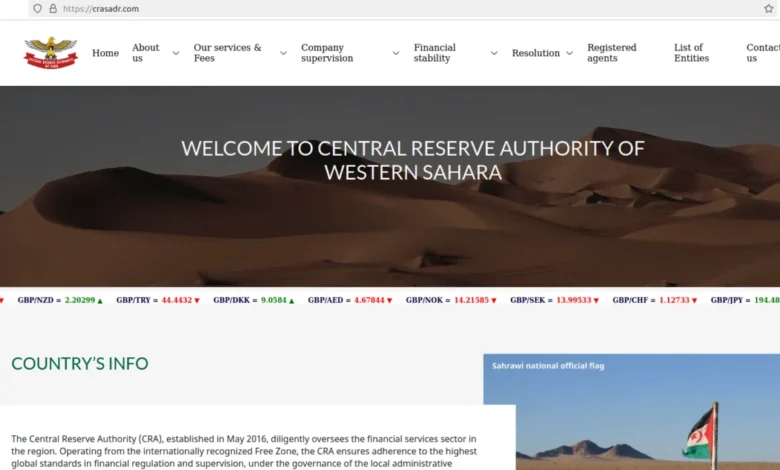
One of the most bizarre elements of the Cryptomus investigation is the facade of regulatory legitimacy the platform constructed. The parent company, Certa Payments, claimed to be overseen by a "regulatory body" known as the WS Management and Advisory Corporation. This organization purportedly managed licensing for crypto, foreign exchange, and gaming businesses in the disputed region of Western Sahara.

Further investigation into this structure revealed a web of shell companies and fake institutions. The website for the "Central Reserve Authority of the Western Sahara" (crasadr.com) functioned as a storefront for these licenses, sharing server infrastructure with the very platforms it was supposedly regulating. This "regulatory theater" allowed Cryptomus to present itself as a licensed entity to unsuspecting merchants and users, masking its true function as a conduit for systemic money laundering. The central shareholder of these entities was identified as a 25-year-old Ukrainian national, a figurehead whose role highlights the ease with which sophisticated cyber-criminal networks can manufacture the appearance of corporate compliance.
Broader Impact and Future Implications
The impact of the U.K. sanctions is expected to be profound, not only for the targeted platforms but for the broader cryptocurrency industry. By cutting off access to the sterling market, the U.K. has set a precedent that other jurisdictions are likely to follow. The immediate reaction of the Cryptomus Telegram support bot—which confirmed on October 8 that the platform was "suddenly unable to process transactions"—suggests that the sanctions have already disrupted their core operational capabilities.
The implications for Russia’s "wartime economy" are equally significant. As global banking sanctions have tightened, Russia has increasingly relied on decentralized or semi-centralized crypto-gateways to pay for dual-use technologies and bypass trade restrictions. By targeting the specific plumbing that connects crypto assets to the fiat world, the U.K. is effectively raising the "cost of doing business" for Russian state-sponsored actors and cyber-syndicates.
Moving forward, the success of this action will depend on international cooperation. If the U.S. Treasury’s Office of Foreign Assets Control (OFAC) and other global regulators follow the British lead, the remaining viability of platforms like Cryptomus will likely evaporate. The era of "no-KYC" payment processors acting as an unregulated, global banking system for illicit actors is rapidly coming to an end, replaced by a more aggressive, sanction-heavy approach to digital finance.
For the victims of ransomware, human trafficking, and fraud, these sanctions represent a vital, albeit belated, step toward accountability. However, the ease with which these platforms have rebranded and migrated across jurisdictions suggests that the cat-and-mouse game between regulators and cyber-criminal syndicates will continue to evolve, necessitating constant vigilance and enhanced international intelligence sharing. The "Western Sahara" ruse serves as a stark reminder that in the world of digital crime, the most sophisticated defenses are often built upon the most transparently fraudulent foundations.
Related posts: